
You’ll begin the program with a full-body training split, meaning you’ll train all major bodyparts in each workout (as opposed to “splitting up” your training). Train three days this first week, performing just one exercise per bodypart in each session. In a warm-up, you generally look for a gradual increase in intensity. Basically a form of “raising your pulse” and increasing your body’s temperature and heart rate. Now there are A LOT of dynamic warm ups, and I suggest looking up a handful.
THE POWER OF PROTEIN
To boost the workout, add an exercise ball under the hips, knees, or feet. Make sure you are deloading at the end of those 4-6 weeks. The deload week is when you do half as many sets, and half as many reps but with the same weight you used on your final week.
- What you do outside the gym matters just as much as your workouts.
- This app is amazing and my coach and team are even more amazing.
- Leave at least one day between hard sessions for a muscle group, aim for seven or more hours of sleep, and stay hydrated throughout the day.
- If you have a strong and solid foundation with strength training using barbells and machines, the intermediate plan is most appropriate for you.
- The Smith machine is a staple in many gyms—a barbell fixed on steel rails, moving only up and down in a straight path.
- For example, you can do goblet squats instead of back squats or triceps pushdowns instead of dips.
Optimizing Performance from the Inside Out

One advantage of full-body workouts is improved muscle symmetry. We all know that friend with a huge chest and skinny legs because they skip leg day. Full-body workouts help prevent overcompensation in certain muscle groups. Instead of having a single big leg day that feels daunting just to think about, you can do one or two leg exercises in each workout and still get the necessary volume to grow. Before moving on to the cardio portion of the workout, be sure you’ve completed 20 minutes of resistance training. If you have, now’s a good time for a water break to keep your body well-hydrated.
What To Know Before Getting Started
Then, once you get confident in those movements, feel free to add some variety. Pick one exercise from EACH category above, specifically ones that scare you the least, and that will be your workout every other day for the next https://www.youtube.com/shorts/bhndOH5pYJk week. We will pick 4 exercises and get really strong with those movements. This approach allows for more volume while still protecting your recovery.
Kneeling squat
These are just a few of the most popular 3-day split workouts. You can customize these workouts to the fullest extent and ensure you use the gym to your advantage for your goals. Try to do two sets of 8-10 squats at least three times weekly. You will know that you need to change your workout plan if you are getting bored with the exercises, feeling tired, or aren’t seeing the progress that you were anticipating.
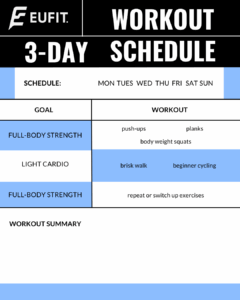
Complete 2 sets of 10 to 15 reps of each exercise below, then move on to the next after 1 minute of rest. Planks are a full-body exercise that can improve overall strength, stability, and athletic performance while reducing your risk of injury. This is why adequate nutrition, hydration, and sleep on rest days are essential for muscle hypertrophy. Sleep is the time when most of this recovery happens (25), but a full day off from training provides a larger window for these processes. Choose 3-4 days a week that you can realistically commit to exercising.
Week 2: Split Decision
Draw your shoulder blades gently back and keep your neck neutral. Keep wrists straight, and leave a soft bend at the elbows or knees at the end of each rep. These posture cues apply to most strength machines. For standing or cable-based exercises, focus on keeping your spine neutral and your core engaged throughout the movement. Set the seat so your feet rest flat on the floor or platform and your hips feel steady against the pad. Align the machine’s pivot with the joint that moves.
Cable Pull Down: For Upper Back
Come up onto the toes to lift the heels off of the ground. Holding a weight in each hand, hinge forward at the hips with a flat back. Hug your elbows in toward your sides, and kick the weight toward the back of the room by moving the arm below the elbow only. Feel the back of your arm tighten as you press the arm back, and then release it back to the starting position. The Smith machine is a staple in many gyms—a barbell fixed on steel rails, moving only up and down in a straight path.
Why Beginners Should Start with Gym Machines
When you’ve already developed enough strength for bodyweight squats, try doing goblet squats to prepare for barbell squats. Plus, beginners typically don’t need to train more than three times per week. That’s enough to provide a good stimulus and grow without feeling overwhelmed or overtrained. Recovery is strongly individual and depends on your experience level, genetics, nutrition, stress outside the gym, and the amount of training you do in each session. As such, you should determine how much recovery you need by considering post-workout soreness, your daily energy levels, and the quality of your sleep.
Advanced workout routine for men to try
In the fourth and final week of the program, you’ll train four days in a four-way split that hits each bodypart just once (except for calves and abs, which are each trained twice). As you’ll see, chest and triceps are paired up, as are back with biceps and quads with hamstrings, each a very common pairing among novice and advanced bodybuilders. Shoulders are trained more or less on their own, and you’ll alternate hitting calves and abs—which respond well to being trained multiple times per week—every other workout. No new exercises are introduced in Week 4 so that you can focus on intensity in your workouts instead of learning new movements. Building a successful fitness foundation isn’t about finding the “perfect” workout, but about applying proven principles with consistency. By structuring your week with a balance of full-body strength training, purposeful cardio, and dedicated rest, you’ll create a sustainable system for progress.
weeks of intelligent programming
For example, if on your first set of lat pulldowns you used 140 pounds for eight reps, try using 120 or 130 pounds on set two and 100–120 pounds on set three. The exercises listed in Week 1 are a collection of basic moves that, while also used by advanced lifters, we feel are suitable for the beginner as well. Notice we’re not starting you off with only machine exercises; a handful of free-weight movements are present right off the bat.